

Italy is a country with a very diverse landscape that offers many opportunities for off-road travel. A large part of the country consists of mountains and hilly terrain, with valleys, agricultural areas, and long stretches of coastline in between. Outside the main transport routes, many quieter regions can be found.
A characteristic feature of Italy is two major mountain systems: the Alps in the north and the Apennines running through much of the country. In many regions, there are mountain roads, forest tracks, and gravel roads connecting small towns and rural areas.
Off-road driving conditions in Italy
In Italy, you can find many mountain roads, gravel roads, and local dirt tracks leading through mountainous and less populated regions. In the Alps and the Apennines, some routes run high in the mountains and may be steep or rocky. Driving conditions often depend on the weather and the season.
In many regions of Italy, there are restrictions on driving off-road and accessing certain mountain roads. Some routes are seasonally closed or only accessible with special permits. In practice, off-road travel mainly involves using existing mountain and gravel roads.
Wild camping in Italy
In Italy, wild camping is restricted or prohibited in many regions. This especially applies to national parks, nature reserves, and popular tourist areas. In many places, local regulations govern camping.
Travelers most often use campsites, agritourism accommodations, or small hotels in smaller towns. In mountainous regions, it is sometimes possible to find parking spots used by locals, but it is always necessary to make sure that local regulations are not violated.
Information for drivers
For entry into Italy, EU citizens only need a valid ID card or passport. Italy is part of the European Union and the Schengen Area, so there are usually no border checks. Drivers should carry a valid driving license, vehicle registration document, and third-party liability insurance.
Italy has right-hand traffic. Low beam headlights must be used outside built-up areas during the day and always in tunnels. Standard speed limits are typically 50 km/h in built-up areas, 90 km/h outside built-up areas, 110 km/h on expressways, and 130 km/h on motorways.
Motorways in Italy are toll roads, and fees are collected at toll booths. Fuel stations are widely available on main roads and in cities, but in mountainous regions they may be spaced further apart.
Price levels in Italy
Italy is more expensive than many Central and Eastern European countries. Costs of accommodation, restaurants, and tourist services vary depending on the region. In popular tourist areas, prices can be noticeably higher than in less known parts of the country.
Travel safety in Italy
Italy is generally a safe country for travel. However, on local roads and in the mountains, caution is advised, as some sections are narrow and winding. In mountainous regions, changing weather conditions and seasonal road closures should also be taken into account.
Basic information about Italy
- area – 301,340 km²
- population – about 59 million
- capital – Rome
- currency – euro
- language – Italian
Tourist attractions in Italy
Italy offers many well-known historical and natural attractions. The most recognizable include Rome with the Colosseum and the Roman Forum, Venice with its canals, and Florence with its historic center. It is also worth visiting the Dolomites, the lakes of northern Italy, and numerous historic towns and villages across the country.
Latest off-road routes Italy
-
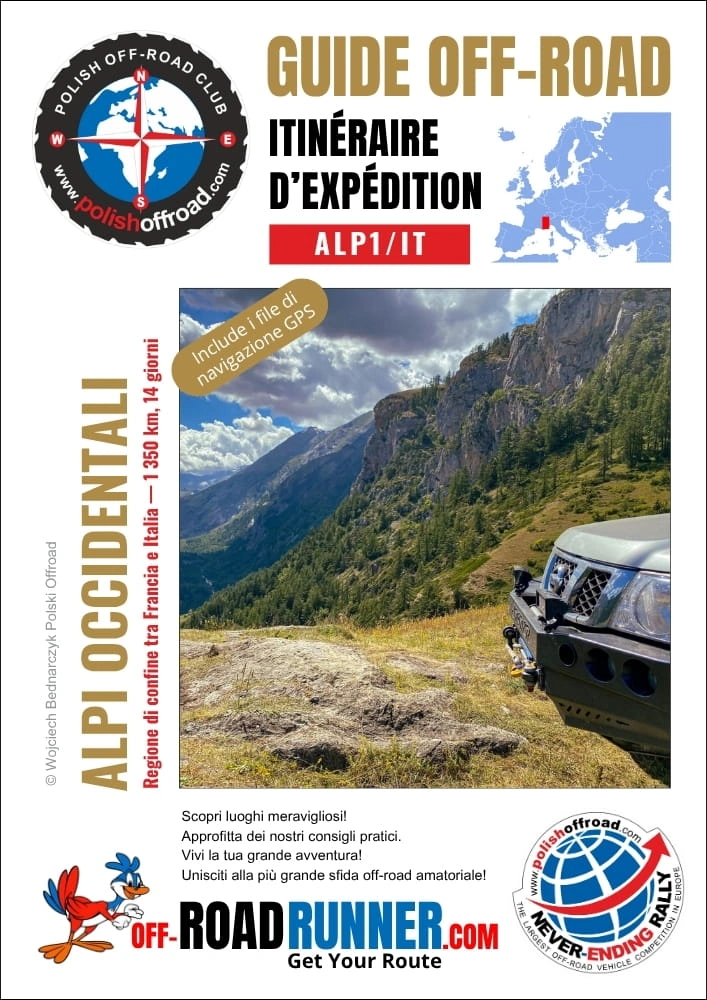
Western Alps 4×4 Off-Road Route
1350 km of off-road routes in the Western Alps. 14 days on military 4×4 roads up to 3000 m. Scenic and legal route. Description and GPS files
See also: