

Albania is a country with a highly diverse landscape, where short distances connect high mountains, deep river valleys, and the coastline of the Adriatic and Ionian Seas. A large part of the country is mountainous, and many regions outside the main cities remain sparsely urbanized. Thanks to this, Albania has for years attracted drivers looking for routes through raw, natural, and less transformed areas.
The landscape of Albania is shaped mainly by mountain ranges, rocky valleys, wide views, and numerous passes. In the northern part of the country, more wild mountains dominate, while in the south there are scenic roads running along the sea and through dry, rocky hills. This diversity of terrain is what makes off-road routes in Albania completely different from those in lowland countries.
Off-road driving conditions in Albania
In Albania, off-road routes most often use mountain roads, rocky gravel roads, old roads connecting remote villages, and local roads leading through passes and valleys. In many regions, these are long stretches with limited traffic, numerous bends, steep climbs, and sections with damaged surfaces. The driving character is therefore more mountainous and technical than in northern Europe.
In Albania, vehicles are allowed to drive only on roads. It is not permitted to drive off-road outside designated roads or to move through protected areas in a way that violates nature protection regulations. In practice, off-road travel here mainly consists of driving on dirt and gravel roads that have retained their local, often raw character.
Wild camping in Albania
In Albania, wild camping is in practice quite common and has long been popular among travelers using off-road vehicles, campers, and motorcycles. In many mountainous and rural regions, it is easy to find places away from buildings, with plenty of space and little traffic.
However, when camping, you should avoid private land without the owner’s permission, national parks and reserves, areas with restrictions, and locations close to the border. In practice, travelers most often stay off the main routes, along mountain roads, by rivers, or near small villages, maintaining caution and cleanliness.
Information for drivers
To enter Albania, citizens of the European Union need a valid passport or a valid ID card. Albania is not part of the European Union or the Schengen Area, so a border crossing is required. Drivers should carry a valid driving license, vehicle registration document, and third-party liability insurance.
If the vehicle does not belong to the driver, it is also advisable to have a document confirming the right to use it. When traveling with your own vehicle, the most important thing is to have a complete set of basic vehicle and driver documents, as road checks in Albania are also encountered outside major cities.
In Albania, traffic drives on the right-hand side. Low beam headlights must be on during the day. In built-up areas, the speed limit is usually 40 km/h, outside built-up areas most often 80–90 km/h, and on highways up to 110 km/h, unless signs indicate otherwise.
The road network in Albania is mostly free of charge, but a toll applies on a section of the A1 highway related to the Kalimash tunnel. Fuel stations are available throughout the country, but in mountainous and less populated regions, distances between them may be greater.
Price levels in Albania
Albania is usually cheaper than many European Union countries, especially when it comes to restaurant meals, accommodation, and everyday expenses. However, fuel prices are not among the lowest in the region, so it is worth considering this cost when planning a longer route.
Travel safety in Albania
Albania is currently considered a country where it is possible to travel independently without major problems, also outside the main tourist areas. When traveling by off-road vehicle, greater challenges than personal safety are often road conditions, local driving style, lack of lighting outside cities, and mountain sections requiring caution.
Basic information about Albania
- area – 28,748 km²
- population – approximately 2.4 million
- capital – Tirana
- currency – Albanian lek
- language – Albanian
Tourist attractions in Albania
Albania offers many interesting places to visit during a trip. The most well-known are the Albanian Alps in the north of the country and the Albanian Riviera with scenic roads along the Ionian Sea. It is also worth visiting the historic towns of Berat and Gjirokastra listed as UNESCO sites, the archaeological site of Butrint, Lake Shkodra, and the areas around the passes and valleys of southern Albania, where driving combines with very wide panoramas.
Why choose off-road routes in Albania
- long mountain roads and scenic passes
- raw landscapes of valleys, rocks, and high ranges
- many routes with a more off-road character
- combination of mountains, historic sites, and coastline in one country
- possibility of camping in many remote locations
- interesting cuisine and Balkan travel atmosphere
Latest off-road routes Albania
-
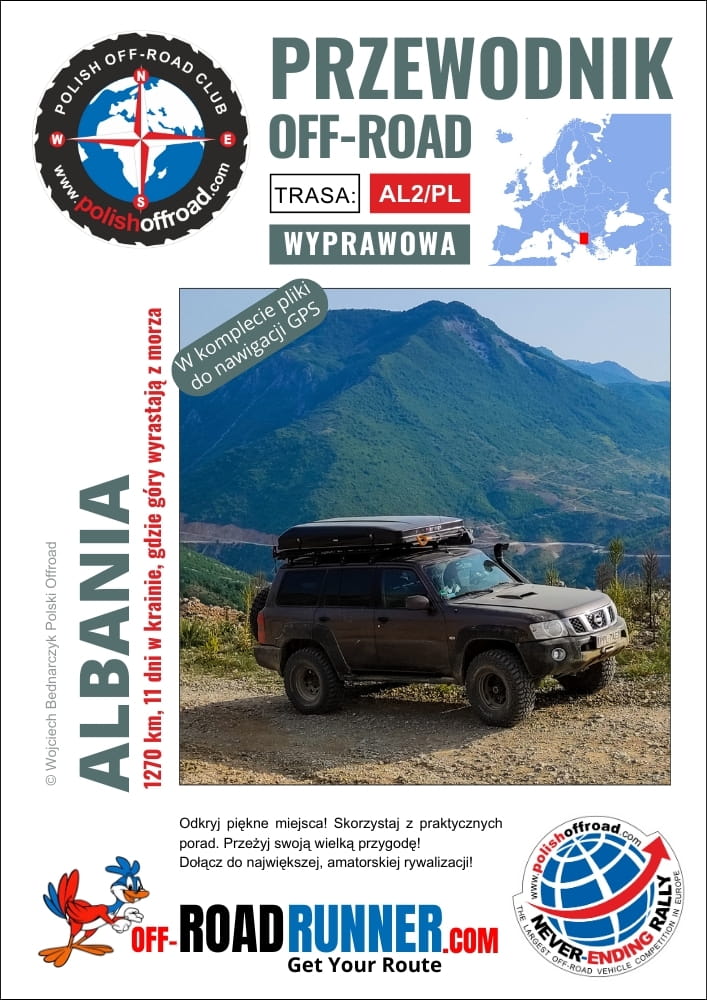
Albania AL2/EN 4×4 Off-Road Route
Opis trasy Trasa off-road Albania AL2/PL stanowi część dłuższej, bałkańskiej trasy prowadzącej przez Rumunię (Przewodnik RO5/PL), Bułgarię (Przewodnik BG1/PL) i Grecję (Przewodnik GR1/PL), dzięki czemu może być wykorzystana jako kolejny etap wielodniowej wyprawy. Zakłada wjazd do Albanii od strony Grecji i prowadzi z południa na północ. Kończy się na granicy z Czarnogórą. Została przygotowana tak,…
-
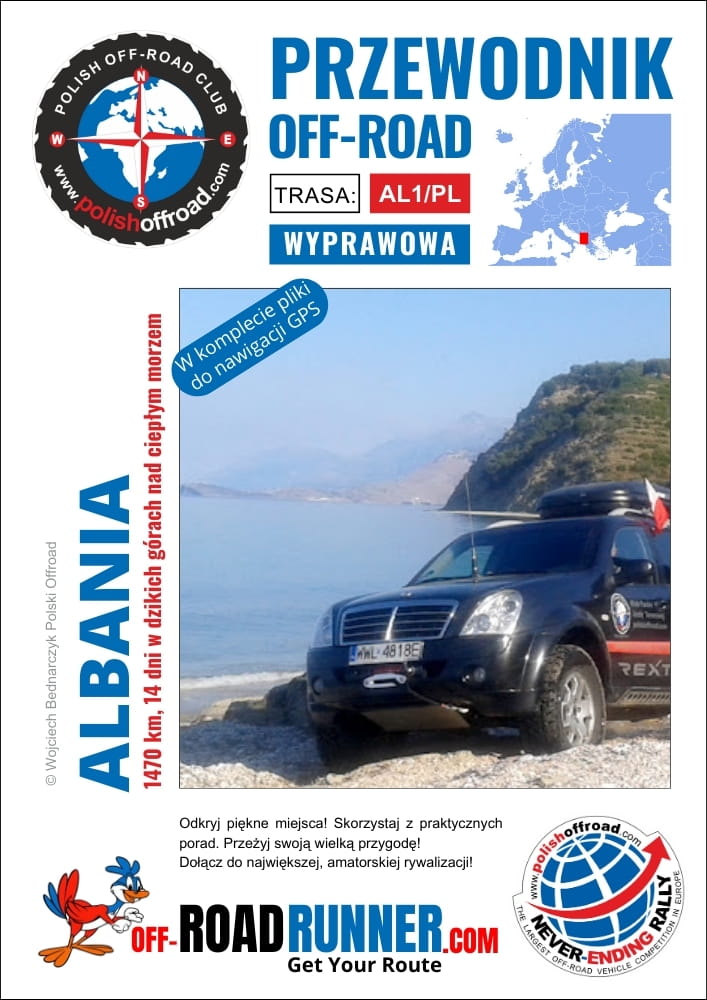
Albania AL1/EN 4×4 Off-Road Route
Opis trasy Trasa off-road Albania AL1/PL prowadzi przez terytorium jednego z najciekawszych krajów dla fanów jazdy terenowej w Europie, który wyróżnia się dużą swobodą podróżowania i biwakowania oraz zróżnicowanym krajobrazem. Obejmuje odcinki w górach o alpejskim charakterze oraz fragmenty na wybrzeżu z kurortami i dzikimi plażami. To trasa, która pozwala w jednym wyjeździe zobaczyć najbardziej…
See also: