

The Balkans is a vast region of Southeast Europe covering many countries with a highly diverse landscape. The region includes high mountains, extensive forest areas, river valleys, and the coasts of the Adriatic, Ionian, and Aegean Seas. In many places outside major cities, sparsely populated regions can still be found.
The landscape of the Balkans is largely shaped by numerous mountain ranges, including the Dinaric Alps and mountain ranges in the southern part of the peninsula. Between them lie valleys, small towns, and roads leading through mountainous and rural areas.
Off-road driving conditions in the Balkans
In many Balkan countries, there is an extensive network of mountain roads, forest roads, and gravel roads running through mountains and less populated areas. Depending on the country, routes may lead through rocky mountain roads, gravel passes, and roads used by local communities.
Traveling by off-road vehicle in the region should take place only on existing roads. Driving off-road outside designated roads or into protected areas may be prohibited. In practice, most off-road routes use mountain roads and dirt roads connecting small towns.
Wild camping in the Balkans
In many regions of the Balkans, overnight stays in nature are common among travelers, especially in mountainous and less populated areas. However, in some countries there are regulations restricting camping in national parks or protected areas.
When planning overnight stays, private land and restricted areas should be avoided. In practice, travelers often stay overnight in the mountains, on clearings, or in locations away from large towns.
Information for drivers
For traveling in the Balkans, citizens of the European Union usually only need a valid ID card or passport, although in some countries a passport is required. Drivers should carry a valid driving license, vehicle registration document, and liability insurance.
In most Balkan countries, traffic drives on the right-hand side. Speed limits and road regulations may vary depending on the country. In many countries, road tolls or vignettes also apply on selected roads.
Fuel stations are widely available in cities and along main roads. In mountainous and less populated regions, they may be spaced further apart.
Price levels in the Balkans
In many Balkan countries, prices are lower than in Western Europe. However, costs of accommodation, restaurants, and fuel vary depending on the country and region. In popular tourist resorts, prices may be higher than in less visited areas.
Travel safety in the Balkans
Traveling in the Balkans is generally safe, but in mountainous areas caution should be exercised while driving. Roads may be narrow, winding, and sometimes in poorer technical condition. In the mountains, changing weather conditions should also be taken into account.
Basic information about the Balkans
- region – Southeast Europe
- countries – including Albania, Bulgaria, Croatia, Montenegro, Greece, North Macedonia, Serbia
- largest cities – Athens, Sofia, Belgrade
- currencies – vary by country
- languages – vary by country
Tourist attractions in the Balkans
The Balkans offer many well-known historical and natural sites. The region includes numerous national parks, mountains, lakes, and historic cities. Popular destinations include the Adriatic coast, the mountainous regions of Montenegro and Albania, as well as historic cities and monuments spread across the peninsula.
Latest off-road routes in the Balkans
-

Off-road route Balkans 4×4
The Balkans off-road route is a special option for crews focused on a long journey. The route covers 7,500 km through Romania, Bulgaria, Greece and Albania. We recommend allocating 36 days, as this allows you to limit daily driving to about six hours and still have plenty of time for sightseeing, tasting regional drinks and…
-

Bulgaria and Greece BG1/EN 4×4 Off-Road Route
Opis trasy Trasa off-road Bułgaria i Grecja BG1/PL prowadzi przez górzyste obszary zachodniej Bułgarii i kończy się w Grecji nad Morzem Egejskim. To propozycja dla osób szukających dzikiej przyrody, górskich dróg i kontaktu z autentycznym krajem, daleko od nadmorskich kurortów. Może stanowić drugą część dłuższej trasy przez Bałkany, po odcinku przez Rumunię (Przewodnik Off-Road RO5/PL)…
-
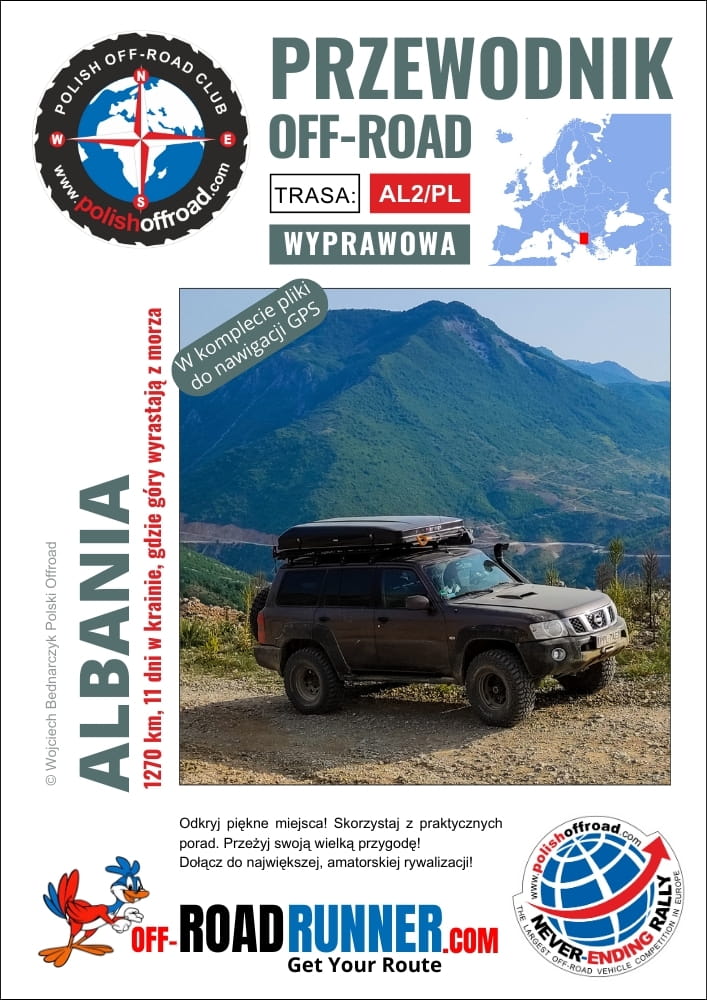
Albania AL2/EN 4×4 Off-Road Route
Opis trasy Trasa off-road Albania AL2/PL stanowi część dłuższej, bałkańskiej trasy prowadzącej przez Rumunię (Przewodnik RO5/PL), Bułgarię (Przewodnik BG1/PL) i Grecję (Przewodnik GR1/PL), dzięki czemu może być wykorzystana jako kolejny etap wielodniowej wyprawy. Zakłada wjazd do Albanii od strony Grecji i prowadzi z południa na północ. Kończy się na granicy z Czarnogórą. Została przygotowana tak,…
See also: